The Artistic Climate of Paris: A City Ready for Change
By the beginning of the twentieth century, Paris had become an extraordinary center of artistic experimentation. The city attracted painters, sculptors, writers, musicians, collectors, and dealers from across Europe and beyond. Artists were no longer working exclusively within the expectations of official academies and established exhibition systems. Independent galleries and alternative exhibitions offered new opportunities for experimentation. The Salon des Indépendants and the Salon d’Automne became important venues for artists who wanted to present work outside the strict conventions of academic art. These exhibitions helped expose audiences to new artistic approaches, including Fauvism, Post-Impressionism, and the early developments that would lead toward Cubism.
Impressionism had already changed the rules
The Impressionists had challenged traditional painting by emphasizing light, atmosphere, and the immediate experience of looking. Artists such as Claude Monet, Pierre-Auguste Renoir, and Edgar Degas had shown that a painting did not need to follow the polished finish and carefully controlled compositions expected by academic institutions. They brought attention to the changing effects of light, modern urban life, and everyday subjects. But by the end of the nineteenth century, some younger artists felt that Impressionism had not gone far enough. They wanted to explore the underlying structure of things rather than concentrating primarily on the changing appearance of light. This desire helped give rise to Post-Impressionism.
Post-Impressionism: Beyond the surface
Post-Impressionism was not a single organized movement, but rather a broad term used to describe artists who developed new approaches beyond Impressionism. Paul Cézanne explored structure and form. Vincent van Gogh emphasized expressive brushwork and emotional color. Paul Gauguin experimented with simplified forms, symbolic imagery, and areas of flat color. Georges Seurat investigated color theory and the systematic application of small dots of pigment. These artists did not share one unified style, but they all expanded the possibilities of painting. For the future Cubists, Cézanne’s contribution would prove especially important.
Henri Matisse and the rise of Fauvism
Another important development was Fauvism, a movement associated with Henri Matisse, André Derain, Maurice de Vlaminck, and other artists. Fauvist painters used unusually strong, often non-naturalistic colors. A landscape might contain vivid reds, greens, blues, and oranges that did not correspond to the colors found in nature. Their objective was not necessarily to create an accurate representation of the scene, but to use color as an independent expressive force.
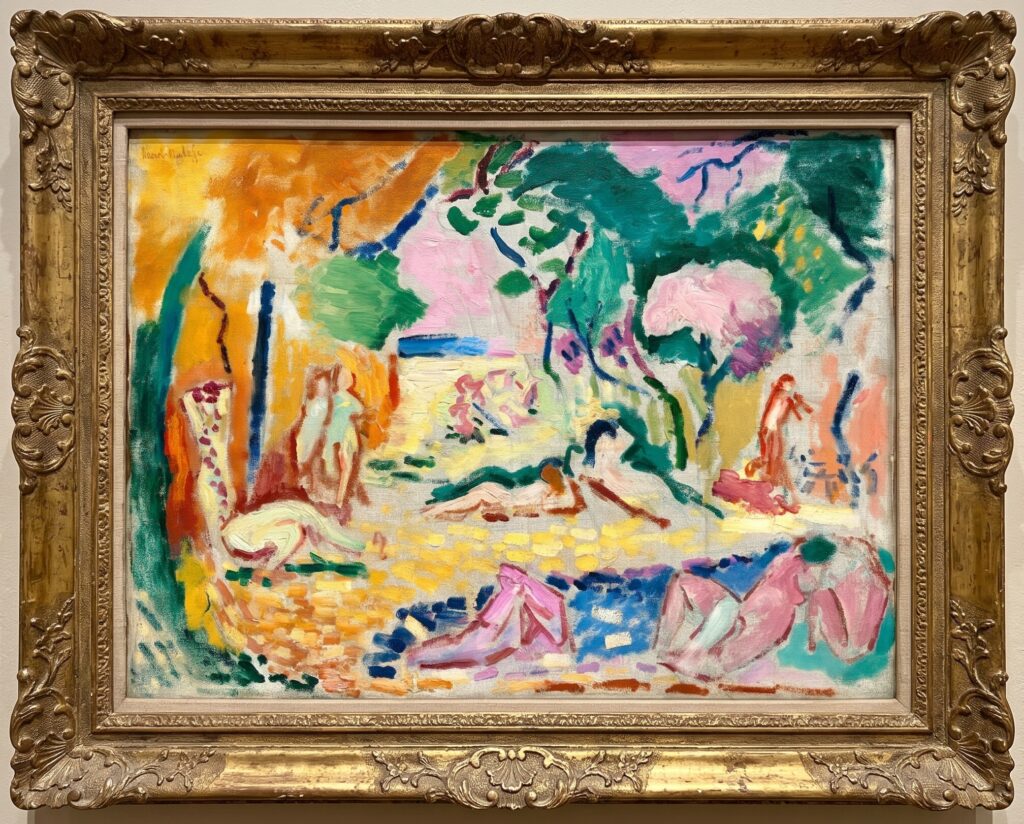
Matisse’s Le Bonheur de Vivre 1905–1906 is an important example.
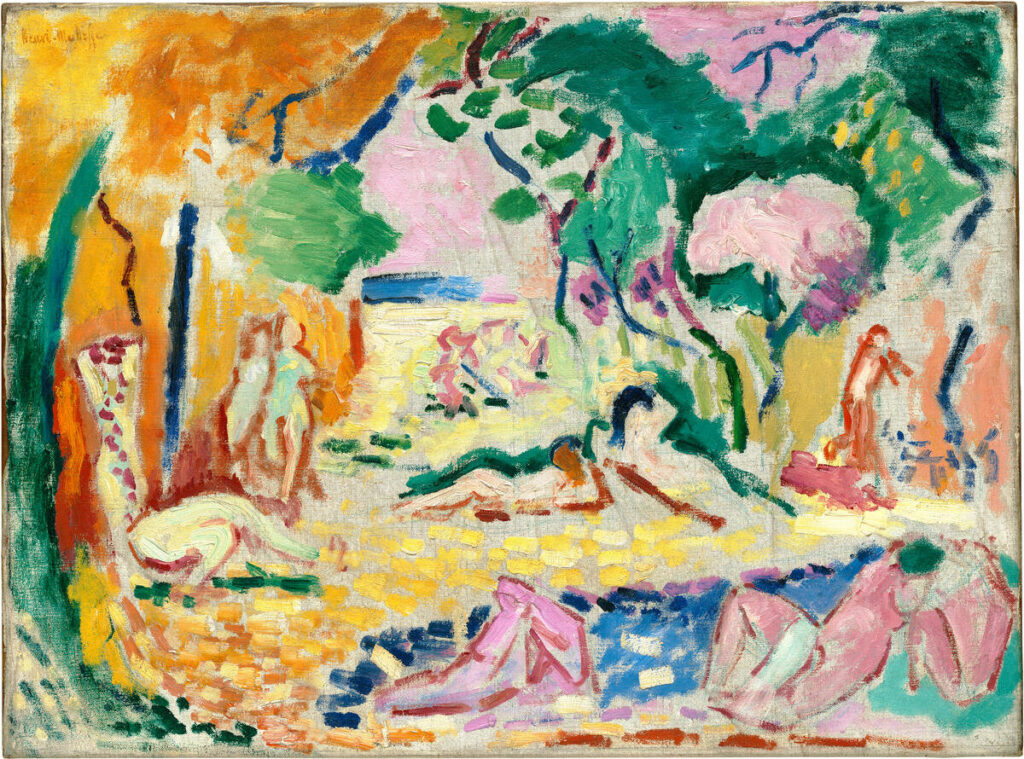
The painting presents a pastoral scene with simplified figures, flowing contours, and areas of intense color. Its composition is decorative and expressive, rather than strictly realistic. Picasso was aware of Matisse’s work, and the two artists became important, sometimes competitive figures in the development of modern art. Their artistic rivalry would help energize the Parisian avant-garde.
Why this matters to Cubism
By 1907, the traditional rules of painting had already been challenged from several directions. Impressionism had loosened the academic approach to light and brushwork. Post-Impressionism had emphasized structure, color, and individual interpretation. Fauvism had liberated color from strict naturalistic representation. Cézanne had demonstrated that the visible world could be reorganized through geometric relationships. And Picasso’s encounters with Iberian and African sculpture were opening new possibilities for representing the human figure. Cubism would bring many of these questions into a radically different visual system.
The Road to 1907: Picasso Begins to Transform the Human Figure
As these artistic developments were taking place around him, Picasso was undergoing a major transformation of his own. Having moved to Paris at the beginning of the century, he was developing an increasingly personal approach to painting. His earlier Blue Period and Rose Period had established him as a remarkable young artist, but by 1906 he was moving toward a more monumental and structurally simplified style. His attention was shifting from the emotional atmosphere of a painting toward the underlying organization of the image. The human figure became one of his most important subjects.
The Blue Period and Rose Period: An earlier foundation
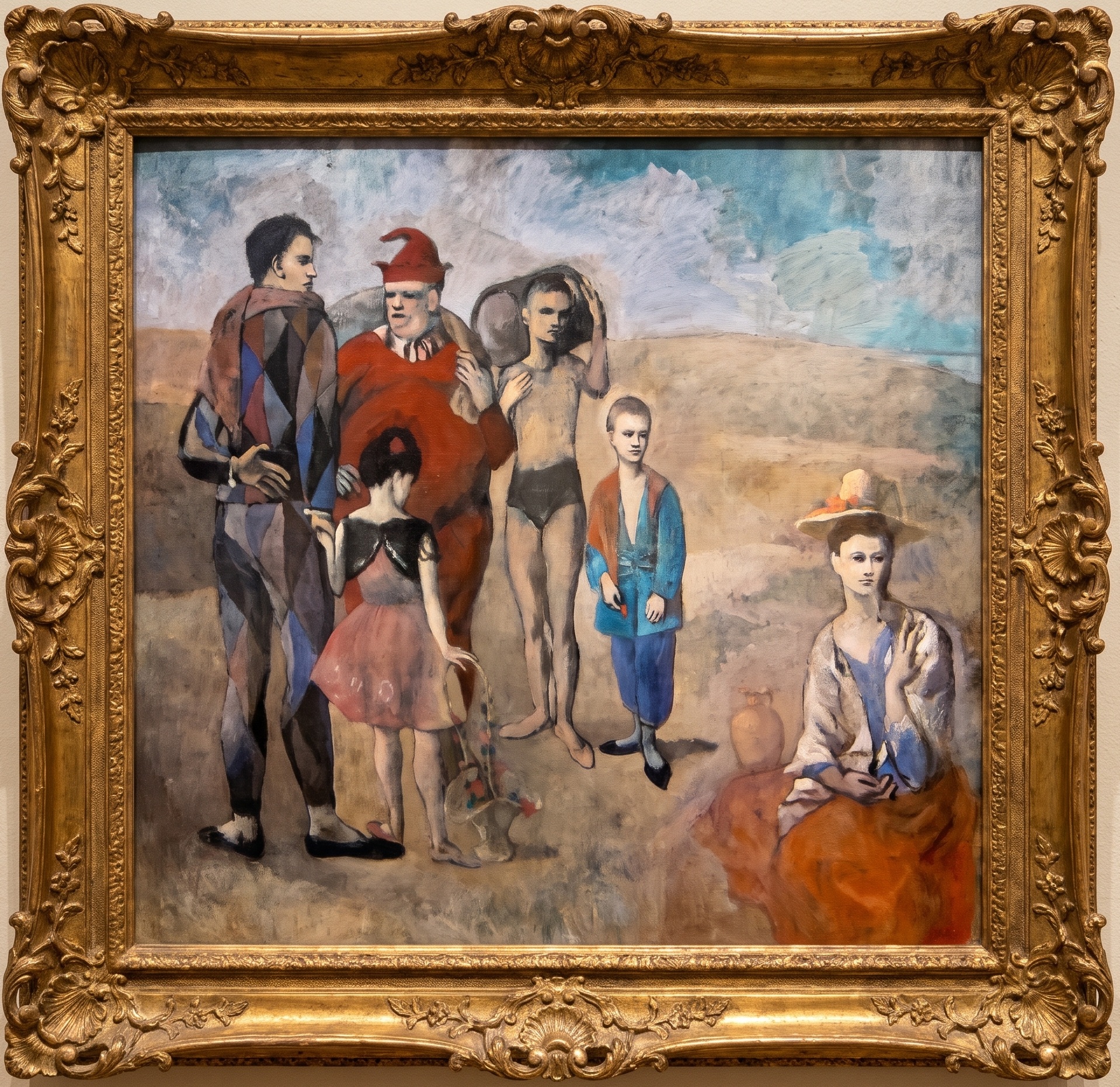
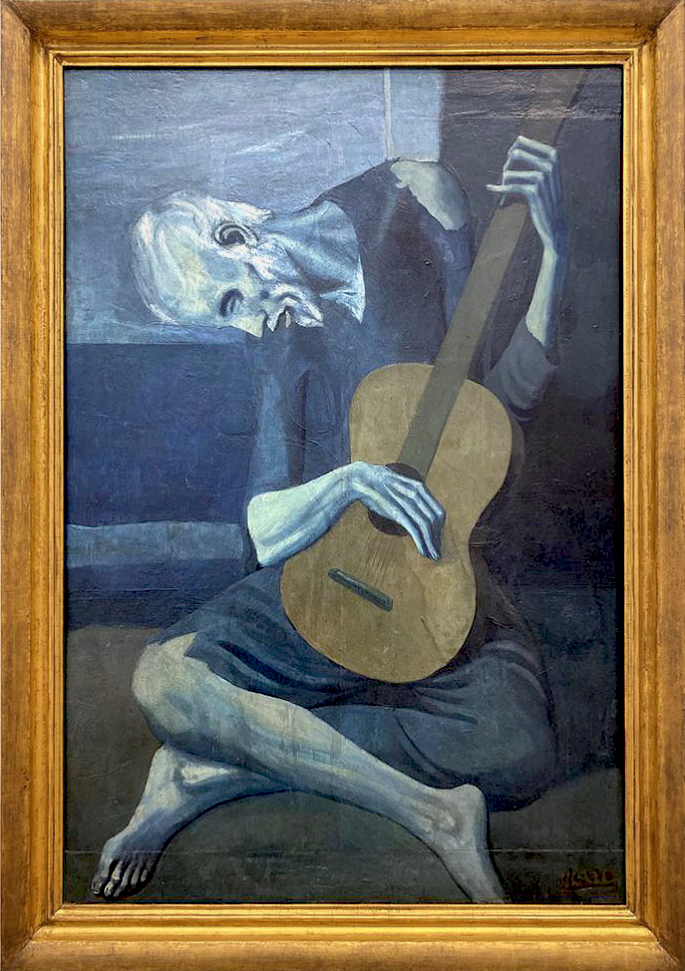
Picasso’s Blue Period (approximately 1901–1904) was characterized by somber colors, emotional subjects, and figures often associated with poverty, isolation, and hardship. Paintings such as The Old Guitarist 1903 demonstrate his ability to use color and simplified forms to create a powerful emotional atmosphere. His Rose Period (approximately 1904–1906) introduced warmer colors, particularly pinks and ochres, and often featured circus performers, acrobats, and entertainers. One notable painting is Family of Saltimbanques 1905. These earlier periods are not Cubism, but they are important to understanding Picasso’s artistic development. His figures were already becoming increasingly monumental and simplified. By 1906, his work was moving toward a more sculptural understanding of the body.
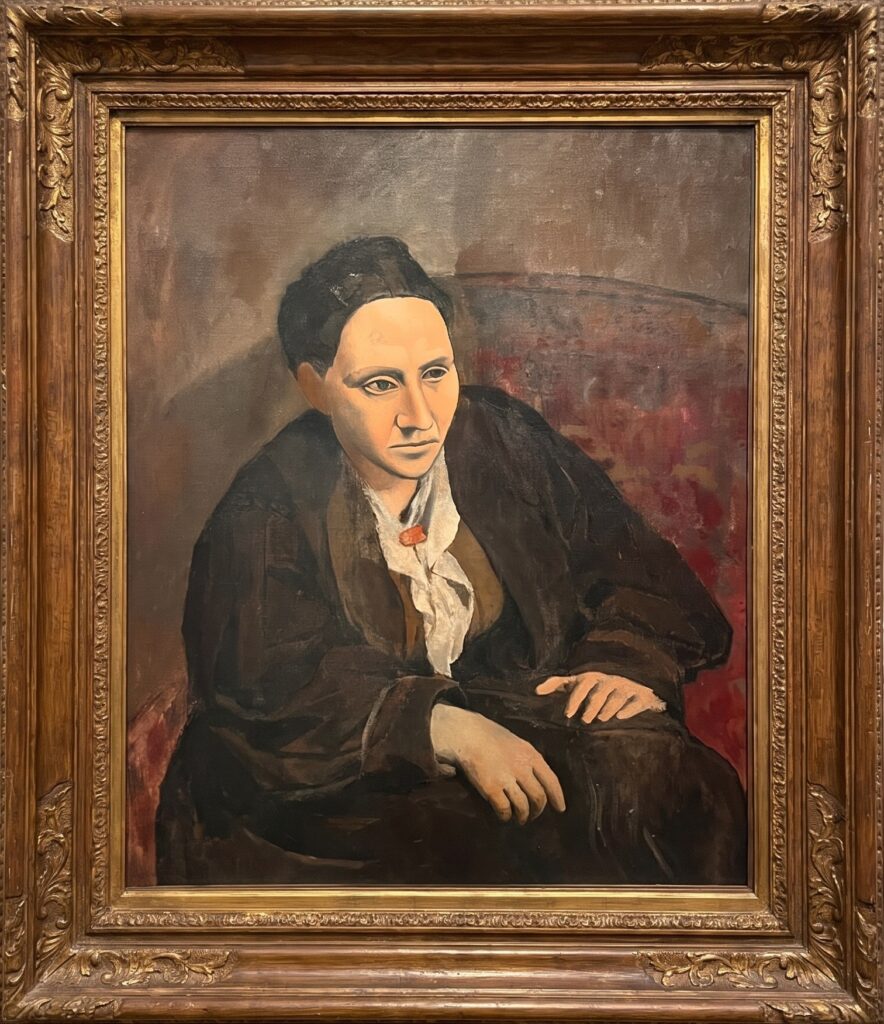
Important painting: Gertrude Stein 1905–1906
Picasso’s portrait of the American writer and art collector Gertrude Stein is another significant milestone. Stein was an important figure in the Parisian avant-garde and a supporter of modern art. Her home became a gathering place for artists and writers, including Picasso and Matisse. Picasso’s portrait of Stein is notable for its simplified face and monumental treatment of the figure. According to the familiar account, Picasso worked on the portrait over an extended period, then left Paris for a time. When he returned, he reworked the face in a much more simplified and mask-like manner. Although the exact details of the story have been discussed by art historians, the finished portrait reveals a clear movement away from conventional portraiture. The face appears almost sculptural, with strong features and a deliberate lack of naturalistic expression. It is an excellent example of Picasso’s developing interest in the construction of form.
Important painting: Two Nudes 1906
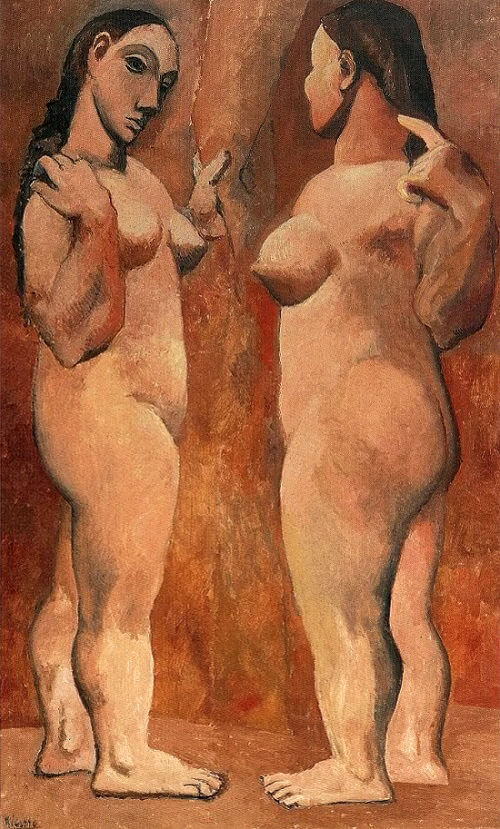
Returning to Two Nudes, it is worth considering the painting as a bridge between Picasso’s earlier work and the radical developments that would follow.
The figures are monumental, simplified, and sculptural.
Their anatomy is no longer treated as a collection of realistic details, but as an arrangement of strong masses.
The painting suggests that Picasso was already moving toward a new visual language.
He was no longer simply trying to represent the body.
He was experimenting with how the body could be constructed on a flat surface.
This distinction would become central to Cubism.
1907: The Final Convergence of Ideas
By 1907, several of the developments discussed above were coming together in Picasso’s work. Cézanne’s approach to geometric structure had opened new possibilities for painting. Iberian sculpture had helped Picasso simplify and reorganize the human face. African sculpture offered another powerful encounter with non-naturalistic forms and expressive abstraction. The artistic environment of Paris encouraged experimentation and challenged the conventions of academic painting. Picasso was now ready to take a much more radical step. Working in his studio at the Bateau-Lavoir in Montmartre, he began developing a large and ambitious painting that would become one of the most controversial and influential works of the twentieth century.
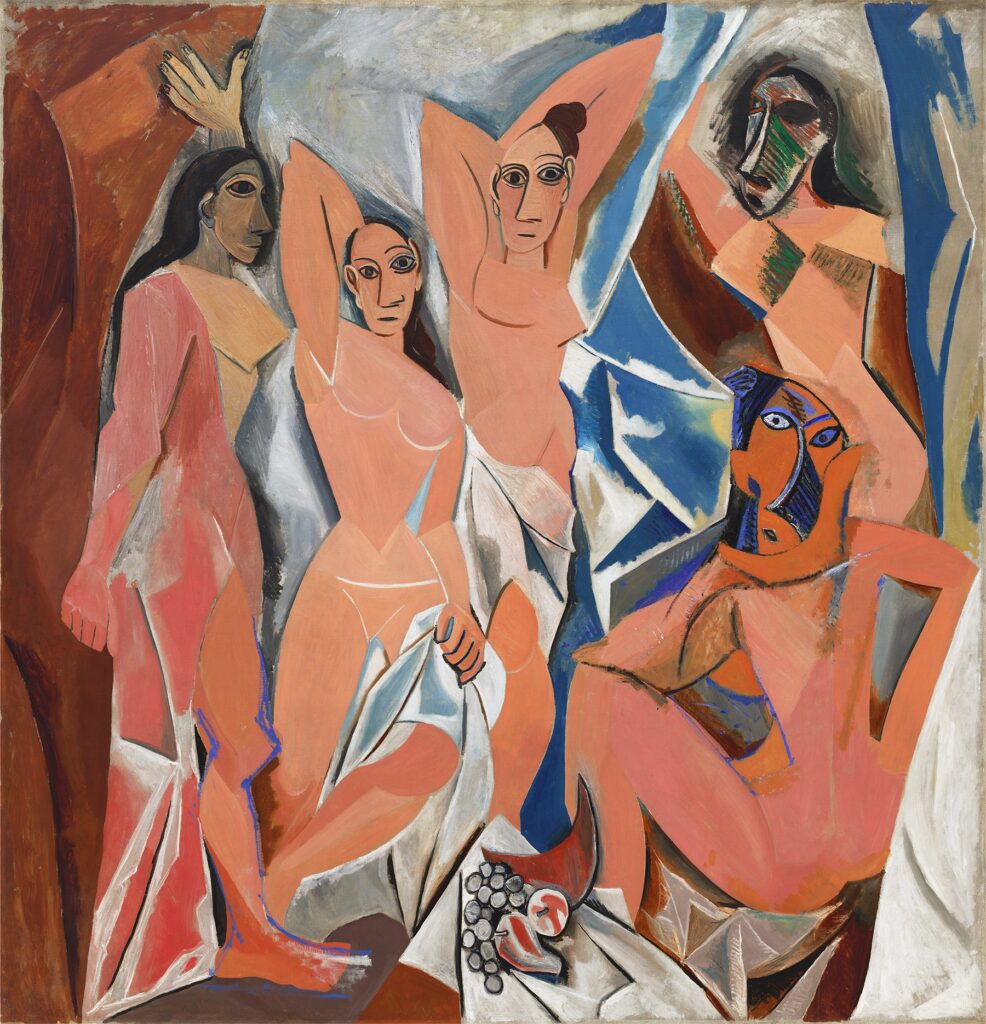
Its original working title was The Philosophical Brothel. It would eventually become known as Les Demoiselles d’Avignon. The painting depicted five nude women in a brothel, but the way Picasso represented them was unlike anything audiences had come to expect. Their bodies were angular and fragmented. Their faces were distorted and mask-like. The space surrounding them was compressed and unstable. Traditional perspective seemed to have broken down. The figures were no longer presented as naturalistic bodies occupying a convincing three-dimensional room. Instead, they appeared to be assembled from overlapping planes and sharply defined forms. The painting was difficult, confrontational, and deliberately unsettling. It was also a major turning point in the history of modern art. Although the work is often described as the beginning of Cubism, it is more accurately understood as a transitional masterpiece that brought together several of the ideas that would soon define the movement. It was not yet Cubism in its fully developed form. That would emerge through the subsequent collaboration between Picasso and Georges Braque. But the old rules of representation had been challenged in a way that could not easily be reversed.
Important painting: Les Demoiselles d’Avignon 1907
This is the essential image for concluding the first chapter. Look closely at the five figures. Their bodies do not follow conventional anatomical proportions. Their faces differ from one another, and some possess striking mask-like features. The two figures on the right are particularly dramatic, with faces that appear sharply distorted and angular. The background and bodies seem to occupy the same compressed space, making it difficult to determine exactly where one form ends and another begins. The painting combines multiple influences and experiments, including Picasso’s earlier studies of Iberian sculpture, his encounter with African art, and the structural ideas associated with Cézanne. It is a work that seems to look both backward and forward: backward toward the artistic traditions and objects that influenced Picasso, and forward toward the radical experiments that would become Cubism.
Conclusion: The Foundations Were in Place
Cubism did not appear out of nowhere. Its foundations were laid through decades of artistic experimentation, cultural encounters, and changing ideas about what painting could accomplish. Paul Cézanne demonstrated that nature could be reconstructed through color, geometric structure, and carefully organized planes. African sculptural traditions introduced European artists to powerful approaches to stylization, abstraction, and the expressive transformation of the human figure, although these traditions had their own independent histories and meanings. Ancient Iberian sculpture provided Picasso with another way to understand the face as a constructed arrangement of forms rather than simply a naturalistic likeness.
Meanwhile, Impressionism, Post-Impressionism, and Fauvism had already loosened the conventions of European painting, encouraging artists to reconsider the roles of color, perspective, light, and representation. By 1907, Picasso had brought many of these ideas together in Les Demoiselles d’Avignon. The painting did not immediately establish the complete language of Cubism, but it signaled that a new direction was emerging. The next step would come through Picasso’s relationship with another artist, Georges Braque. Together, they would begin dismantling the traditional picture plane, breaking objects into geometric fragments, experimenting with multiple viewpoints, and developing a new way of representing the world.
~ The foundations had been laid.
~ Cubism was about to begin.